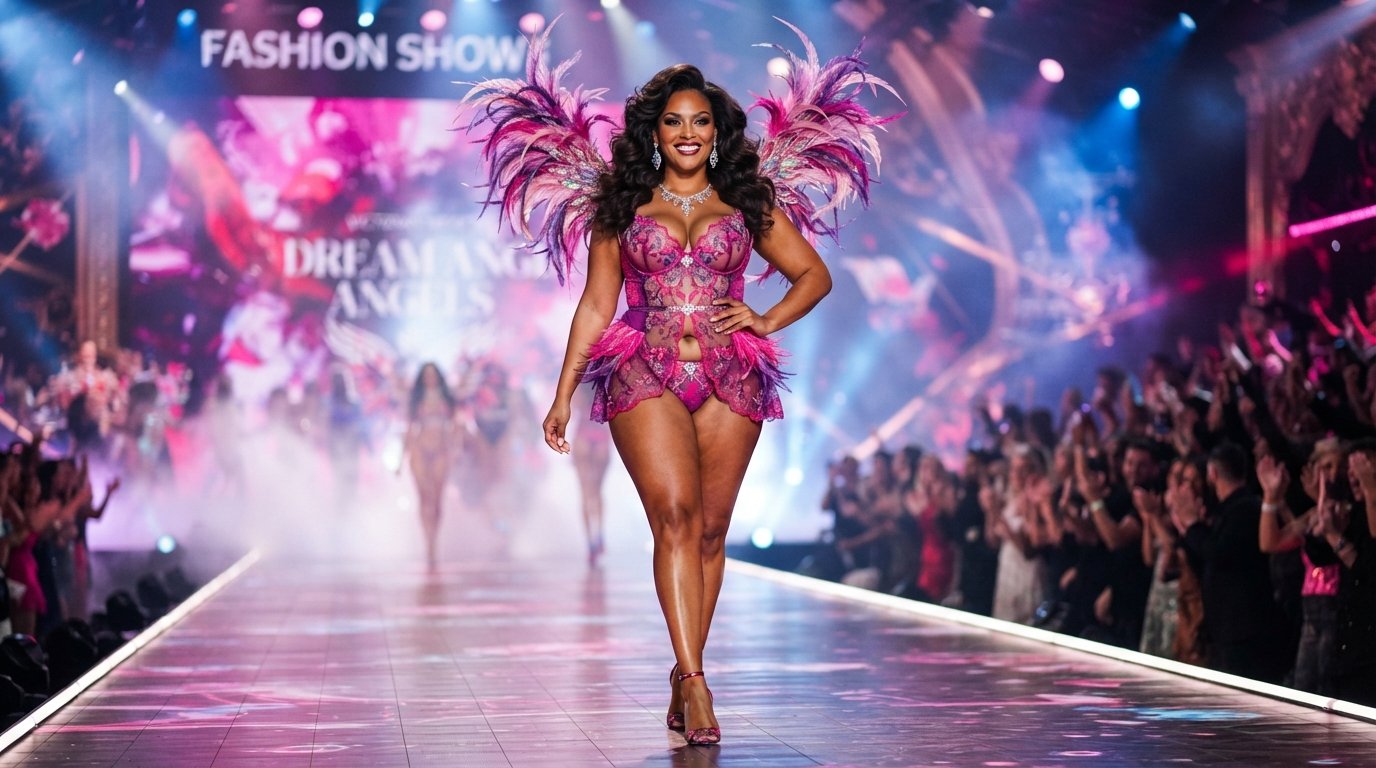
For years, the Victoria’s Secret Angel image was linked with a very specific type of body. Tall. Thin. Polished. And almost impossible for many women to see themselves in.
Curve model Ella Halikas wanted to show another version.
Halikas, who wears a US size 14, recreated the feel of a Victoria’s Secret runway in a photoshoot on the streets of West Hollywood. She wore lingerie and Angel inspired wings while posing and walking in public. The project was not an official Victoria’s Secret campaign. It was her own creative shoot with photographer Henry Jimenez Kerbox.
Her goal was simple. She wanted people to see that confidence, fashion and beauty do not belong to one body size.
The size 14 model Victoria’s Secret photoshoot first gained major attention in 2023. But its message still matters in 2026. Victoria’s Secret has since put more curve models on its official runway. At the same time, new fashion industry data shows that larger bodies remain rare across major fashion shows.
And here is why that matters.
Who Is Ella Halikas, the Size 14 Model Behind the Photos?
Ella Halikas describes herself as a curve model, influencer and speaker. Her own website says she moved to Los Angeles in 2020 to build a full time modeling career. Within about a year, she became a Sports Illustrated Swimsuit model.
Her work has since focused heavily on confidence and body acceptance.
Halikas has built much of her social media presence around showing clothing and fashion on a curvier body. She has also recreated looks that people were used to seeing on thinner celebrities and models.
That made the Victoria’s Secret concept a natural fit.
In an interview about the shoot, Halikas said she wanted to recreate the feel of a Victoria’s Secret catwalk on her own body. She identified herself as a size 14 and said the point was to show that someone could live in a bigger body and still feel healthy, happy and confident.
Her message was bigger than a set of lingerie photos.
She was asking a basic question.
Why should one body type own the fantasy?
Why Did She Create a Victoria’s Secret Inspired Photoshoot?
The classic Victoria’s Secret Fashion Show became famous for dramatic wings, lingerie, confident walks and some of the most recognizable models in fashion.
For many years, the body type shown on that runway was much less varied.
Halikas wanted to put herself inside that familiar visual style.
She teamed up with photographer Henry Jimenez Kerbox for the shoot in West Hollywood. She wore lingerie and wings and posed in public spaces rather than on an official runway. Halikas said models Adriana Lima and Candice Swanepoel were among her inspirations for the concept.
The location mattered too.
This was not a carefully controlled studio where no one could see her.
People were around her as the shoot happened.
Halikas said members of the public watched, took pictures and encouraged her. She also said most of the online reaction she saw was positive, although some people criticized the images.
That mix of reactions is worth remembering.
Body confidence does not mean every person will like every image. The larger point is that women should not need to reach one clothing size before they are allowed to enjoy fashion or feel comfortable being photographed.
What Made the Size 14 Photoshoot Stand Out?
The shoot worked because viewers could recognize the reference right away.
There were wings.
There was lingerie.
There were strong poses.
There was the confident runway attitude associated with the old Victoria’s Secret Angel image.
But this time a size 14 curve model was at the center of it.
Halikas told Fox News Digital that she wanted to show what a size 14 body could look like in lingerie while being confident in public.
That visual contrast gave the images their meaning.
If she had simply taken ordinary fashion photographs, the message would have been different. By using a style that had long been connected with a narrow beauty ideal, she was questioning who people expect to see wearing the wings.
It also made the pictures easy to share.
You did not need a long explanation before you understood the reference.
The wings caught your attention.
The person wearing them made you think.
Why Did the Photos Connect With So Many Women?
Halikas said she received emotional responses from viewers who felt they had missed this kind of representation while growing up. Some told her they wished they had seen more bodies like hers on major runways.
That reaction cannot tell us what every woman thinks.
But research gives us a wider picture of why different body representation may matter.
A 2025 meta analysis studied results from 20 experiments involving 3,603 young female participants.
Researchers compared the effects of idealized body content with body positive content on social media.
The results found that exposure to body positive content produced a small improvement in body satisfaction. Exposure to idealized body content reduced body satisfaction.
The study reported an effect size of 0.20 for body positive content and minus 0.29 for body ideal content.
You do not need to know the math behind those numbers to get the main point.
The images women repeatedly see can affect how they feel about their own bodies.
That does not mean a photo can solve body image concerns.
It means representation is more than decoration.
What Research Says About Body Positive Images
Social media places people in front of a huge number of appearance based images every day.
Some show very narrow beauty ideals.
Others show bodies with different sizes, shapes and features.
The 2025 analysis of 3,603 participants found a clear difference between those two types of content. Body ideal content had a negative effect on body satisfaction. Body positive content produced a smaller positive effect.
The researchers also found something important about video.
Idealized body videos on TikTok were linked with a larger decline in body satisfaction than idealized images on Instagram in the studies they examined.
This matters because fashion is no longer seen mainly in magazines.
People now watch models walking, dressing, posing and talking through short videos all day.
One body positive post will not remove every insecurity.
But seeing different bodies presented with the same confidence and care given to traditional fashion models can offer viewers a wider picture of what beauty can look like.
Halikas’ photos fit into that bigger shift.
Has Victoria’s Secret Actually Become More Inclusive?
Victoria’s Secret looks different today from the company many people remember from its older runway years.
Its 2025 show included major curve models, including Yumi Nu.
British Vogue reported that Nu became the first Asian curve model to walk as a Victoria’s Secret Angel. She wears a US size 14.
That detail creates an interesting connection to Halikas’ earlier shoot.
In 2023, a size 14 model created her own Victoria’s Secret inspired moment because she wanted to see a curvier body inside that famous image.
By 2025, another US size 14 curve model was walking the official Victoria’s Secret runway.
That is real change.
But it would be a mistake to say the problem is solved.
A few visible curve models do not automatically mean the whole fashion industry has become size inclusive.
The numbers tell a much harder story.
The 2026 Numbers Show Fashion Still Has a Size Problem
Vogue Business tracks the body sizes shown across major fashion weeks.
Its Spring and Summer 2026 report counted 9,038 looks across 198 shows and presentations.
Of those looks, 97.1 percent were straight size.
Only 2 percent were mid size.
Just 0.9 percent were plus size, which Vogue Business defined as US size 14 and above.
Then the numbers got worse.
For Fall and Winter 2026, Vogue Business examined 7,817 looks across 182 shows and presentations.
About 97.6 percent were straight size.
Around 2.1 percent were mid size.
Only 0.3 percent were plus size.
That 0.3 percent figure was tied with Fall and Winter 2025 for the lowest plus size representation Vogue Business had recorded since it began tracking the issue.
So yes, seeing a size 14 model on a famous runway matters.
But the wider data says she is still an exception.
Why Representation Needs to Be More Than One Model
There is a difference between visibility and full inclusion.
Visibility means you see a curve model in a campaign or runway show.
Inclusion goes further.
Can customers actually buy the clothes in their size?
Are several body types shown?
Do brands keep hiring larger models next season?
Are bigger samples made for castings?
Is size diversity normal, rather than a special event?
The latest data shows why those questions matter.
Vogue Business found that plus size representation fell from 0.9 percent in Spring and Summer 2026 to just 0.3 percent in Fall and Winter 2026.
The same report also pointed to problems with clothing availability.
In a Vogue Business consumer survey, 48 percent of respondents said they felt pressure to lose weight to feel fashionable. Among that group, sizing problems while shopping were cited more often as a source of pressure than runway shows or brand campaigns.
That tells us something important.
Seeing different bodies is useful.
Being able to dress those bodies matters too.
Ella Halikas Says Fashion Still Has More Work to Do
Halikas has continued speaking about size representation since her viral photoshoot.
In a more recent interview, she said she had seen some progress in modeling, including at brands such as Victoria’s Secret and Sports Illustrated.
But she also said the progress was still not enough and pointed to high fashion as an area that remained limited in body diversity.
Her concern matches the runway numbers.
In September 2025, Halikas also criticized the lack of curve representation she was seeing around New York Fashion Week and said she felt the industry was moving backward in some areas.
Her comments have continued into 2026.
In June 2026, she spoke about body image debates around reality television and said that while fashion had made progress, long term and consistent representation still needed work.
That consistency may be the most important test.
One inclusive season can make headlines.
Several inclusive years can change expectations.
Where Victoria’s Secret Stands in 2026
Victoria’s Secret is preparing for another major runway show.
The company says its 2026 Victoria’s Secret Fashion Show will take place live in Los Angeles on Sunday, October 18, 2026.
It is scheduled to stream on YouTube beginning at 4:30 PM Pacific Time.
The brand has already announced models including Gigi Hadid, Alex Consani and curve model Paloma Elsesser.
Victoria’s Secret has also been using a wider casting process connected with the upcoming show, including its Angels Among Us project. People reported that the company held casting activity in several US cities.
The show has not happened yet as of August 2026.
That means we cannot say how diverse the final 2026 cast will be.
What we can say is that the company now publicly presents a broader range of models than it did during much of its earlier runway history.
The next question is whether that approach lasts.
What the Size 14 Victoria’s Secret Inspired Photoshoot Means in 2026
Ella Halikas did not create an official Victoria’s Secret campaign.
She created her own version of the fantasy.
That distinction matters.
Her photoshoot showed how a familiar fashion image could feel different when the expected body type changed.
Since then, official Victoria’s Secret runways have included more curve representation. Yumi Nu, another US size 14 model, walked as an Angel in 2025. Paloma Elsesser is among the models announced for the 2026 show.
Yet the fashion industry as a whole has not moved at the same pace.
Just 0.3 percent of the looks counted by Vogue Business for Fall and Winter 2026 were shown on plus size models.
That is why Halikas’ photos still have meaning.
The issue was never simply whether one size 14 woman could wear lingerie and wings.
Of course she could.
The bigger question was whether fashion could make room for different bodies without treating their presence as unusual.
Beauty Does Not Need One Clothing Size
Ella Halikas’ size 14 model Victoria’s Secret photoshoot started with lingerie, wings and a recognizable runway idea.
But the conversation around it became much bigger.
Research now shows that body positive media can have a small positive effect on body satisfaction, while idealized content can have the opposite effect. Victoria’s Secret has also put more curve models on its official runway.
Still, the wider fashion numbers show how far there is to go.
Real progress will be easier to see when different body sizes stop feeling surprising on a runway, in an advertisement or inside a clothing store.
The question for fashion brands is no longer whether curve models can belong in these spaces.
They already do.
The question is whether brands will keep making room for them.