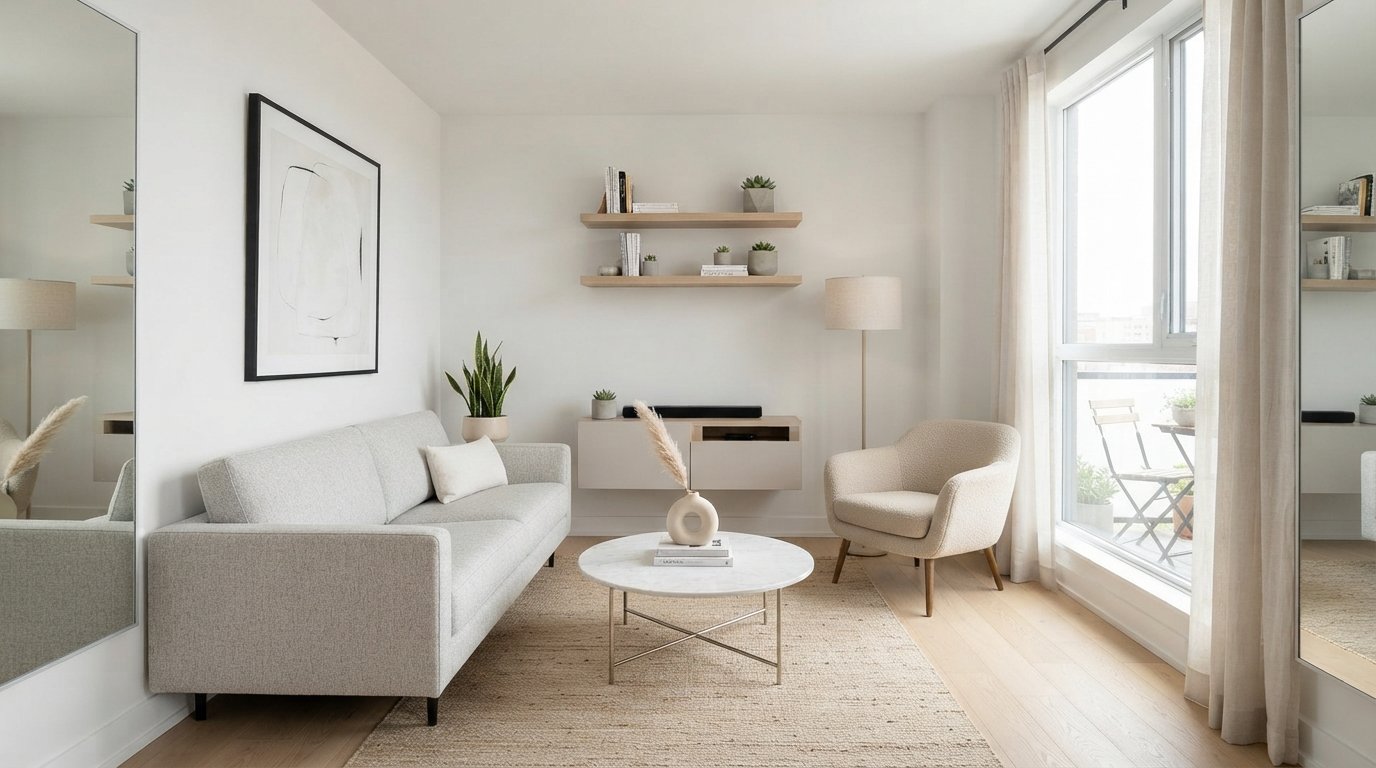
A small living room can feel crowded even when you do not own that much.
The problem is usually not the room itself. It is how the space is being used.
Too many small tables, bulky furniture, open storage, tangled cables and random decor can make a compact room feel busy fast.
That is why space saving minimalist living room ideas work so well.
The goal is not to remove everything you like. It is to make each item earn its place.
A good minimalist living room still feels warm and comfortable. It simply uses less furniture, better storage and a clearer layout.
Current small space advice also supports this approach. IKEA recommends multifunctional furniture, movable tables, storage seating and better lighting for very small living rooms. Architectural Digest also notes that reducing visual clutter can make a living room feel calmer even when the room is already clean. (IKEA)
Here are practical ideas you can use in apartments, condos and small homes.
1. Choose a Sofa That Fits the Room
The sofa is usually the largest item in a living room.
That means one oversized sofa can make the whole room feel cramped.
Measure the wall before buying anything.
Leave enough space to walk around the sofa without squeezing past other furniture.
A small two seat or compact three seat sofa may work better than a large sectional.
Look for simple arms and clean shapes.
Wide rolled arms can take up valuable floor space without giving you more seating.
You can also consider a sofa with visible legs.
Seeing more floor under the furniture can make a compact room feel less visually heavy.
The best sofa is not the biggest one you can fit.
It is the one that leaves the room easy to use.
2. Use Furniture That Does More Than One Job
Multifunctional furniture is one of the easiest ways to save space.
IKEA specifically recommends items such as sofa beds and storage pouffes for very small living rooms because one piece can handle more than one task. (IKEA)
Think about what you need before buying separate pieces.
A storage ottoman can work as:
A footrest
Extra seating
A small table with a tray
Hidden storage
A sofa bed can give you daytime seating and a place for overnight guests.
A storage bench can provide seating while hiding blankets, toys or games.
The idea is simple.
If one piece can replace two pieces, your room gains more open space.
3. Replace a Large Coffee Table With Smaller Tables
A large coffee table can dominate a small living room.
You may not need one.
Try two nesting tables instead.
You can keep them together when you need more surface space and separate them when guests arrive.
A small side table can also work.
IKEA recommends lightweight tables and movable trolleys in small spaces because they can be moved where they are needed instead of taking up one fixed area all day. (IKEA)
Tables on wheels can be useful too.
Move them beside the sofa when you need a drink or laptop.
Push them away when you need more floor space.
Flexible furniture makes a small room easier to change.
4. Use Closed Storage to Cut Visual Clutter
Open shelves look good in photos.
They can also become cluttered very quickly.
If your living room stores remote controls, chargers, children’s toys, paperwork, games and random household items, closed storage may work better.
Use cabinets with doors or drawers.
Keep attractive objects on display.
Hide everyday mess.
IKEA recommends mixing open and closed storage so useful objects remain easy to reach while less attractive items stay hidden. (IKEA)
This approach also supports minimalist design.
You do not have to own less immediately.
You simply stop showing everything at the same time.
That can make a surprising difference.
5. Mount the TV on the Wall
A large TV stand can use valuable floor space.
If your wall and TV allow it, mounting the television can create a cleaner setup.
You can place a narrow cabinet below it or remove the media console completely if you have another place for devices.
Keep cables controlled.
Visible wires can make even a simple room look messy.
Use cable covers, clips or a hidden cable channel when possible.
A wall mounted TV also lets you use the area below for storage without needing a deep entertainment unit.
IKEA has used wall mounted TV setups with storage ottomans and simple tables in its own multifunctional small living room examples. (IKEA)
The result is less furniture around one of the busiest parts of the room.
6. Use the Walls for Storage
Small rooms often run out of floor space before they run out of wall space.
Use that height.
Floating shelves can hold books, plants and small decor.
Wall cabinets can store things without taking up much floor area.
Tall bookcases can also work if they are narrow.
The trick is to avoid filling every inch.
One vertical storage area is usually better than several small cabinets scattered around the room.
Keep the lower part of the room visually simple.
That helps the space feel calmer.
7. Choose a Few Larger Decorations
Minimalist rooms do not need empty walls.
They need controlled decoration.
Instead of hanging ten small pieces of art, try one large piece.
Instead of filling a shelf with fifteen decorations, keep three or four objects that you actually like.
This reduces visual noise.
Architectural Digest recently highlighted visual clutter as a common reason living rooms can feel overwhelming even when the space is technically clean. (Architectural Digest)
A few larger items often look calmer than many tiny ones.
This works with art, plants, lamps and decorative objects.
Give each piece room to breathe.
8. Keep the Color Palette Simple
Too many competing colors can make a small room feel busy.
Choose a simple base.
Warm white, soft beige, pale gray and light taupe are easy options.
Then add one or two stronger colors.
For example:
Cream walls
Light brown sofa
Black lamp
Green plants
Or:
White walls
Gray sofa
Blue cushions
Natural wood
You do not need to make everything white.
Minimalism is more about control than one specific color.
A repeated color palette helps separate pieces of furniture feel connected.
That makes the room look more planned.
9. Use Light Wood for a Softer Minimalist Look
A minimalist room can feel cold if everything is white, gray and metal.
Wood helps.
Light oak, ash and similar finishes can add warmth without making the room look heavy.
You can use wood on:
Coffee tables
TV cabinets
Side tables
Shelving
Picture frames
A small amount is enough.
IKEA’s current multifunctional living room examples often combine simple storage with light wood, white finishes and plants to keep compact rooms functional without feeling sterile. (IKEA)
That is a useful formula for small homes.
10. Leave Some Floor Space Empty
Empty floor is useful.
Do not feel pressure to fill every corner.
One of the fastest ways to make a small living room feel crowded is placing furniture around every wall.
Choose what the room needs first.
Usually that means:
Sofa
One table
Lighting
Storage
Then stop and look at the room.
Do you really need another chair?
Do you need two side tables?
Does that decorative bench have a purpose?
Open floor space makes it easier to walk through the room.
It also gives the furniture you keep more visual impact.
11. Use a Rug to Define the Sitting Area
A rug can make a compact room feel more organized.
It creates one clear sitting zone.
This is especially useful in open apartments where the living room shares space with a kitchen or dining area.
Choose a rug that relates to the sofa and main furniture.
Do not automatically buy the smallest rug available.
A very small rug floating in the center can make the seating area feel disconnected.
Try to have at least the front legs of major seating touch the rug when your layout allows it.
Keep the pattern simple if the room already has several textures and colors.
The rug should help organize the room, not compete with it.
12. Try a Storage Ottoman Instead of an Extra Chair
Most homes need extra seating sometimes.
That does not mean you need a large armchair sitting empty every day.
A storage ottoman can work better.
Use it as a footrest most of the time.
Move it when someone needs a seat.
Open it when you need to store blankets or other small items.
This is exactly the type of flexible furniture recommended for very small living rooms. (IKEA)
It is especially useful in studio apartments.
You get seating without committing much permanent space.
13. Pick Furniture With Visible Legs
Heavy furniture that reaches all the way to the floor can make a small room feel more packed.
Furniture with legs leaves some floor visible underneath.
Try this with:
Sofas
Sideboards
TV units
Side tables
Chairs
You do not need every piece to have thin legs.
The goal is simply to reduce the amount of solid furniture filling your sightline.
This also makes cleaning under furniture easier.
That matters in a compact home where dust becomes visible quickly.
14. Use Lighting That Does Not Steal Floor Space
A large floor lamp can look beautiful.
It can also take up space you need.
Use wall sconces, clamp lamps or small table lamps when possible.
IKEA’s small space guidance includes adjustable lighting that attaches to another surface so the lamp does not need its own floor area. (IKEA)
You can also use pendant lights if your room setup allows them.
Layering several smaller light sources can make the room feel warmer than depending on one bright ceiling fixture.
Place light where you need it.
You do not need a lamp in every corner.
15. Keep Window Treatments Simple
Large curtains with heavy fabric can visually shrink a compact room.
Try simple curtains or shades.
Hang curtain rods higher than the top of the window when possible.
This can make the window area feel taller.
Choose fabric that fits the room’s needs.
If privacy is the main issue, light filtering curtains may work.
If glare is a problem, thicker curtains can help.
IKEA’s own multifunctional living room examples use blackout curtains where screen glare needs to be controlled. (IKEA)
Function comes first.
Minimalism does not mean choosing thin curtains when they do not solve your problem.
16. Create One Clear Focal Point
A small living room becomes messy when everything tries to get attention.
Choose one focal point.
It might be:
A large piece of art
A beautiful sofa
A fireplace
The TV wall
A large window
Then keep nearby decor quieter.
If the focal point is artwork, avoid filling every surrounding wall.
If the sofa is colorful, keep cushions and rugs more controlled.
One focal point gives the eye somewhere to settle.
That can make the room feel more organized without changing its actual size.
17. Remove Furniture That Is Rarely Used
This sounds obvious.
It is also one of the hardest steps.
Look at every piece in your living room.
Ask when you last used it.
That second side table may have looked useful when you bought it.
But if it only holds dust, remove it.
The same goes for unused stools, decorative chairs and storage baskets.
Minimalist design works best when the room reflects how you actually live.
Do not furnish for an imaginary version of your life.
Keep the pieces you use.
18. Give Every Small Item a Home
Small items create clutter faster than large furniture.
Think about:
Remote controls
Keys
Chargers
Headphones
Game controllers
Children’s toys
Books
If these objects do not have a storage place, they will stay on tables.
Use one drawer, box or basket for each group.
Do not buy twenty organizers before you sort your things.
Start with what you already own.
Then add storage only where you actually need it.
Closed storage works especially well because it keeps these everyday items nearby without leaving them visible. (IKEA)
19. Create Flexible Zones in One Room
A small living room may need to do more than one job.
It might be:
A TV room
A home office
A guest space
A reading area
A play area
Trying to build permanent furniture for every job can quickly fill the room.
Use flexible zones instead.
A small table beside the sofa can become a laptop desk.
A sofa bed can turn the living room into a guest room.
A movable trolley can hold craft supplies during the day and roll away later.
IKEA’s current small room guidance focuses strongly on this kind of flexibility. (IKEA)
Your room does not need to look the same all day.
20. Mix Open and Closed Storage Carefully
Not everything needs to disappear behind a door.
A totally closed room can feel flat.
Display the objects that add personality.
Books you love can stay visible.
A plant can sit on a shelf.
A framed photo can stay out.
Then hide the practical items.
Cables, paperwork, toys and extra electronics usually look better inside storage.
IKEA recommends this exact mix of displayed items and hidden storage for creating a calmer living room. (IKEA)
Think of open storage as decoration.
If you would not intentionally display an item, it probably belongs behind a door.
21. Avoid Buying Tiny Furniture Just Because the Room Is Small
A common mistake is filling a small living room with lots of tiny furniture.
Small sofa.
Tiny chair.
Tiny table.
Tiny shelves.
The room can end up looking more crowded because there are too many separate pieces.
It is often better to use fewer items at a comfortable scale.
One proper sofa may look calmer than a small loveseat plus three chairs.
One storage cabinet may work better than four little shelves.
Minimalism is about reducing the number of competing objects.
It is not about making every object miniature.
22. Use Mirrors With a Purpose
A mirror can add another reflective surface and help move light around a room.
Place one where it makes sense.
Across from a window can work well.
So can a wall that would otherwise feel empty.
Avoid adding several mirrors just because you read that mirrors make rooms larger.
One good mirror is usually enough.
Choose a frame that fits your color palette.
A simple wood or black frame works in many minimalist living rooms.
Treat the mirror as part of the room’s design.
Do not use it as a trick.
23. Keep Plants Controlled
Plants can make a minimalist room feel warmer.
But twenty small plant pots can become another form of clutter.
Try one larger plant.
Or use two or three plants at different heights.
Keep pots simple.
Choose plants based on the actual light in your room.
Do not buy a plant just because it looked good in a Pinterest photo.
If your living room gets little natural light, pick something suited to those conditions or use another decorative object.
Minimalism works better when your decor is easy to maintain.
24. Make Storage Blend Into the Room
Storage does not always need to look like storage.
Choose cabinets close to the wall color when possible.
This can make them feel less dominant.
IKEA has used this technique in budget living room examples by painting cabinets to coordinate with the walls while using the inside for toys, books and household items. (IKEA)
Built in looking storage can be especially helpful in small rooms.
You gain practical space without adding another strong visual element.
This works with white walls and white cabinets.
It can also work with darker colors.
Matching matters more than the specific shade.
25. Do a Visual Clutter Check Before Buying Anything
Before you buy new furniture or decor, stand at the doorway.
Look at the room.
What catches your attention first?
Then look for:
Loose cables
Crowded shelves
Too many small decorations
Extra tables
Unnecessary baskets
Stacks of papers
Furniture blocking walkways
Architectural Digest’s recent guidance makes an important point. A living room can feel visually cluttered even when it is technically clean. (Architectural Digest)
So cleaning is not always the answer.
Sometimes the room simply has too many visible elements.
Remove or hide a few things before buying anything new.
You may discover that the room already has everything it needs.
The Best Minimalist Living Room Starts With Less, Not More
A small living room does not need more decorating tricks.
It needs better decisions.
Start with furniture that fits.
Choose pieces that can handle more than one job.
Use closed storage for everyday mess.
Keep walkways open.
Control small decor.
Move storage up the walls when floor space is limited.
Most importantly, stop treating every empty corner as a problem that needs furniture.
Current small space guidance supports flexible furniture, movable pieces and smart storage because these choices let one room handle several needs without becoming overcrowded. (IKEA)
The best space saving minimalist living room ideas are often the simplest ones.
Keep what you use.
Hide what creates clutter.
Leave some space empty.
Your living room will feel calmer, easier to clean and much easier to enjoy.