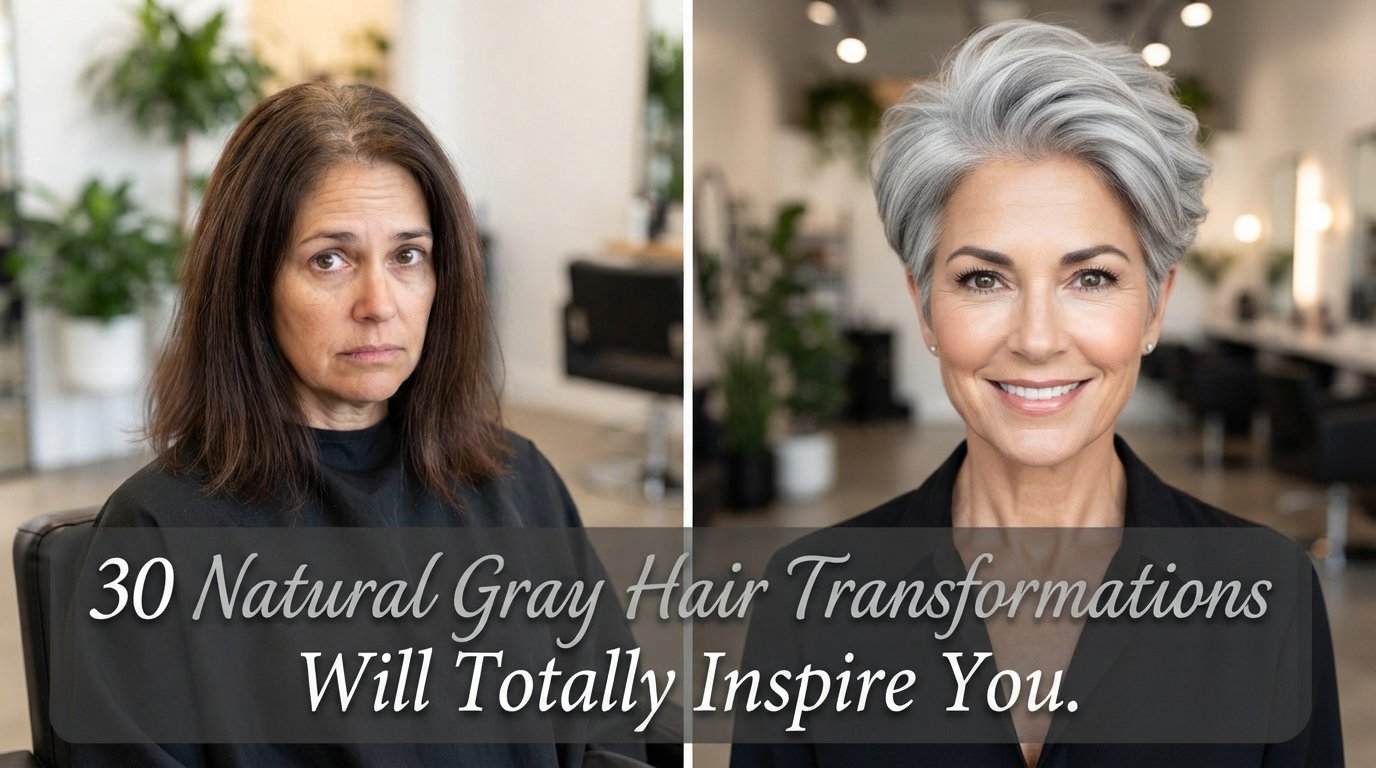
These 30 Natural Gray Hair Transformations Will Totally Inspire You

Growing out gray hair can feel exciting one day and frustrating the next.

You may love the silver coming through at your roots but hate the obvious line where your old color begins. You might also wonder whether gray will suit your haircut, skin tone or natural texture.

The good news is that embracing gray does not require one specific look.

Natural silver can be soft and blended, bright white, salt and pepper, curly, cropped, long or mixed with your old color.

That freedom is a big part of why natural gray hair transformations continue to get attention in 2026.

Current beauty coverage shows that gray blending and what stylists are calling quiet silver have become popular ways to transition without hiding every silver strand. Celebrities including Salma Hayek and Gwyneth Paltrow have also been showing visible gray rather than completely covering it.

If you are thinking about stopping regular root color, these 30 gray hair ideas can help you decide what your next look could be.

1. Dark Brunette to Soft Salt and Pepper Hair

One of the most noticeable gray transformations happens when dark brunette hair begins mixing with silver.

You do not have to wait until every strand becomes gray.

Salt and pepper hair can look beautiful because the natural dark strands create depth while silver pieces add contrast.

Instead of repeatedly covering the roots, ask your stylist whether your existing dark color can gradually be softened.

Gray blending can reduce the hard line between colored hair and natural regrowth.

Vogue reported in 2026 that more clients are asking stylists how to work with their natural gray instead of simply covering it.

This is a strong choice if you still have plenty of naturally dark hair.

2. Dyed Black Hair to Natural Silver

Growing silver out from black dye can be one of the harder transitions.

The contrast is strong.

You may see a bright gray root followed by a dark band of old color.

Do not rush into heavy bleaching at home just to remove the dark section.

A professional colorist may be able to break up that line with careful highlights or other blending techniques.

Another option is simply letting the roots grow while slowly cutting away the old color.

This takes patience, but it avoids forcing your hair through a major chemical process.

The final result can be striking.

Cool silver roots mixed with darker lengths can even look intentional during part of the transition.

3. Brown Hair to Quiet Silver

You do not need to become completely gray overnight.

One of the biggest gray trends of 2026 is quiet silver.

The idea is simple.

Instead of hiding every gray strand, the stylist blends silver into the surrounding hair so the transition looks softer.

Allure describes quiet silver as a way to let gray mix naturally with existing color rather than creating an obvious line between the two.

This can work especially well for brown hair.

Low contrast highlights and cool brown tones can help connect the natural gray roots with previously colored lengths.

It is a useful option if you want to embrace gray gradually.

4. Blonde Hair to Natural Silver Blonde

Blonde hair can offer one of the smoothest routes into gray.

Why?

The difference between pale blonde and silver may be much smaller than the difference between gray and dark brown.

Instead of covering new gray strands, a colorist can often work them into the existing blonde.

Gwyneth Paltrow has been doing something similar.

Vogue reported in June 2026 that her colorist uses a smudging technique to create a softer transition as her gray becomes more visible.

The effect is dimensional rather than one flat color.

If you already have blonde highlights, ask whether they can be adjusted to work with your natural silver instead of fighting it.

5. Long Dyed Hair to a Silver Bob

Sometimes the quickest visual transformation is not color.

It is the haircut.

Cutting long colored ends into a bob can remove a large amount of old dye at once.

That means your natural gray becomes a much bigger part of the finished hairstyle.

One recent real life example comes from Haley Zirbel.

People reported in 2026 that Zirbel began finding gray hair at age 13 and eventually stopped covering it. She later cut her hair into a shorter bob as part of embracing her silver.

A bob can also make the transition easier to maintain because there is less old color left to grow out.

6. Natural Gray Pixie Cut

A pixie can turn gray hair into the main feature instead of something you are trying to disguise.

Short gray styles can look clean, modern and full of texture.

Allure’s 2026 guide to short gray hairstyles notes that the best cut depends on your natural texture, preferred styling time and how polished or relaxed you want the finished look to feel.

That is useful advice.

Do not choose a pixie simply because someone says short hair is best for older women.

Choose it because you like short hair.

Soft layers can make a pixie feel lighter.

Longer pieces on top can give you more styling options.

7. Gray Hair With a Long Pixie

Not ready for a very short crop?

Try a longer pixie.

Keep extra length through the crown and front.

This gives silver hair movement while still removing plenty of previously colored ends.

A longer pixie can also highlight the different shades already growing naturally through your hair.

Some areas may be bright silver.

Others may still be charcoal or dark brown.

Those differences create natural dimension without adding more color.

8. Silver Hair With Face Framing Layers

Your first gray strands often appear around the temples and hairline.

Instead of hiding them, make them part of the style.

Face framing layers can put those lighter pieces front and center.

This works with medium and long hair.

Ask for soft layers around your cheeks, jaw or collarbone depending on your face shape and hair texture.

When the silver pieces fall naturally around the face, they can look more intentional.

You are working with where your hair wants to gray first.

9. Gray Streaks With Dark Hair

You do not need an even mix of silver for gray hair to look good.

Some people naturally develop bold streaks.

Leave them visible.

A bright gray section around the front hairline can become the most recognizable part of your hairstyle.

You can keep the rest of your natural dark hair unchanged.

The contrast creates drama without extra color.

This is especially useful if your gray is concentrated in one or two areas rather than spread evenly across your head.

10. Gray Money Piece With Natural Roots

A natural gray money piece can frame the face almost like a salon highlight.

Instead of repeatedly coloring that front section, let it grow.

Keep the surrounding hair darker.

The result can look deliberate because the silver is concentrated around the face.

This style works particularly well if your temples are naturally much lighter than the rest of your hair.

You are using your natural color pattern rather than trying to create perfect uniformity.

11. Curly Hair With Natural Silver

Gray curls can show incredible dimension.

One curl may appear dark at the base and silver through the middle.

Another may be almost completely white.

That variation can make natural texture even more noticeable.

Do not feel that you need to straighten silver hair to make it look polished.

Current 2026 hair trends are putting more focus on natural texture and lower tension styling rather than forcing hair into very controlled shapes.

Use products that help your own curl pattern rather than fighting it.

12. Silver Afro

Natural gray can look especially striking on coily hair.

The combination of texture and different silver tones creates depth.

A rounded Afro lets both features stay visible.

Focus on shape and moisture.

You can keep the cut neat while allowing the natural texture to remain full.

The goal is not to make gray hair behave like a completely different hair type.

Work with your coils.

A good shape can do far more than excessive styling.

13. Gray Tapered Cut

A tapered cut keeps the sides and back shorter while leaving more texture on top.

This can work beautifully with naturally gray curls or coils.

It also gives you an easier way to remove old color.

As the shorter areas are trimmed, dyed ends disappear quickly.

Keep enough length on top to show the natural silver pattern.

The contrast between closely cut sides and textured silver hair above can make the color stand out even more.

14. Wavy Salt and Pepper Lob

A lob sits somewhere around shoulder length.

That makes it a useful middle ground if you want a noticeable haircut without going very short.

Add natural waves and the different shades of gray become more visible.

Light catches silver strands differently as the hair moves.

A lob can also help remove damaged or heavily colored ends during the transition.

You still have enough length for a ponytail, clips or simple updos.

15. Long Natural Gray Hair

There is no rule saying gray hair needs to be short.

Long silver hair can look beautiful.

The main challenge is keeping the lengths in good condition.

Gray hair can sometimes feel different from your previously pigmented hair.

You may notice changes in texture or manageability.

Use regular trims and adjust your conditioning routine if your lengths feel dry.

Do not cut your hair simply because you have started going gray.

If you love long hair, keep it.

16. Long Gray Hair With Soft Layers

One length silver hair can look dramatic.

But layers can add more movement.

Ask your stylist for long layers rather than cutting away too much length.

This lets the different silver shades fall over one another.

It can be especially useful for thick gray hair.

Layers may remove some weight while keeping the overall length.

The finished result feels softer than a heavy one length shape.

17. Natural Gray Shag

A shag is perfect if you like hair that does not look too controlled.

Use layers around the crown and through the lengths.

Add a fringe if it suits you.

Natural gray gives the cut extra dimension because the layers expose different shades.

Dark strands may sit beside silver ones.

White pieces may appear around the face.

The result can feel modern without hiding your natural color.

18. Silver Hair With Curtain Bangs

Curtain bangs can change your gray hair without sacrificing much length.

They open around the center of the face and blend into longer layers.

If you have stronger silver around your hairline, the fringe can show it off.

Keep in mind that bangs require regular shaping.

If you do not want frequent trims, ask your stylist for longer pieces that can grow into the rest of your haircut more easily.

19. Gray Bob With Side Part

A simple bob can look completely different with a deep side part.

The part exposes different sections of gray and darker hair.

That can make natural color variation look more dramatic.

A side part can also create extra volume at the front.

Keep the bob smooth if you like a polished finish.

Or let your natural wave show for something softer.

The same haircut can work both ways.

20. Sleek Silver Bob

If you prefer a sharper style, try a clean silver bob.

Keep the ends precise.

Wear it straight or with a slight bend.

Bright silver becomes the focus because the haircut itself is simple.

A smooth bob also lets you see the different tones in gray hair clearly.

Some strands may be white.

Others may be steel gray.

That natural variation stops the color from looking flat.

21. Natural Gray With Warm Brown Lowlights

Some people want to embrace gray without losing all warmth.

That is where lowlights can help.

A colorist can add selected deeper pieces while leaving plenty of natural gray visible.

The goal should be blending, not rebuilding your old solid color.

This can work well if your gray is growing in unevenly.

It can also give you a softer transition from previously colored brown lengths.

Talk to your stylist about keeping the contrast gentle.

22. Gray Blending With Fine Highlights

Fine highlights can help connect darker lengths with brighter gray roots.

They should not cover every silver strand.

Instead, they break up obvious lines.

Allure and Vogue have both highlighted gray blending techniques as useful ways to make growing out silver feel more seamless.

This is especially useful if you do not want to cut off your old color.

Just remember that highlights still involve chemical processing.

Ask your stylist whether your hair is healthy enough before adding more lightening.

23. Brunette With Soft Silver Through the Hairline

Jennifer Garner’s recent gray blending look shows how subtle the transition can be.

Glamour described her 2026 color as a soft brunette with quiet silver details that allow natural gray to mix into the overall shade.

This approach is useful if you are not ready to become fully silver.

Keep the brown base.

Let some gray remain visible.

Blend the two rather than choosing one side.

It looks much softer than covering every root with a solid dark dye.

24. Natural Silver Updo

You do not have to wear gray hair down to show it off.

An updo can highlight silver strands around the hairline and temples.

Salma Hayek showed this beautifully in 2026 when she wore her visible silver strands in an elegant updo. Allure pointed to the look as an example of the quiet silver approach.

You can try the same idea with a loose bun.

Leave a few face framing pieces visible.

Do not worry if your gray is not perfectly even.

That variation is part of the look.

25. Silver Ponytail With Natural Roots

A simple ponytail can make your gray pattern more noticeable.

Brush the hair back loosely.

Let the silver roots remain visible.

If your ends still contain old color, the ponytail can also create an interesting mix while you grow it out.

A low ponytail feels softer.

A higher one can look more casual and energetic.

You do not need a complicated hairstyle every time you want your gray to look intentional.

26. White Silver Hair With a Minimal Cut

Some people eventually become much lighter than classic gray.

Their hair may appear almost white.

When your natural color is already that bright, a simple haircut can be enough.

Try a bob, pixie or shoulder length cut with very little extra styling.

Let the color be the feature.

Be careful about automatically using strong purple shampoo every day.

Toning products can be useful when silver hair develops unwanted yellow tones, but excessive use may leave some hair looking dull or overly cool.

Follow the product directions and use it only when your hair actually needs toning.

27. Silver Curls With Dark Underlayers

Gray does not always appear evenly.

You may have bright silver around the top while darker hair remains underneath.

Do not assume this needs fixing.

The contrast can look beautiful on curls because movement reveals the darker layers below.

Keep the color natural and focus on defining the curl pattern.

This gives you depth without using permanent dye.

It is one of the easiest examples of letting your own gray pattern create the design.

28. Gray Hair With a Bold Short Fringe

Want something more dramatic?

Try a short fringe.

A fringe can put silver directly around the face.

Pair it with a bob, shag or short crop.

This works especially well if your hairline is one of the first areas turning gray.

The haircut makes that natural color change look intentional.

Talk with your stylist about how your hair grows before choosing the fringe length.

Cowlicks and natural curl patterns can affect how short bangs sit.

29. Fully Natural Gray After Years of Root Dye

This may be the most satisfying transformation of all.

The repeated root touch ups stop.

The old dye gradually disappears.

Eventually, what remains is your own natural pattern of white, silver, charcoal and darker strands.

That process can take time.

How long depends on your starting length, haircut and growth rate.

You do not need to rush it.

The American Academy of Dermatology confirms that gray hair is a normal part of aging and notes that there is nothing wrong with leaving it gray. It also warns that repeatedly plucking gray hairs can contribute to thinning, while the replacement hair will still grow back gray.

So skip the tweezers.

Let the silver come in.

30. Gray Hair That Looks Completely Like You

The best transformation does not have to be the brightest silver or the shortest haircut.

It should feel like you.

Maybe that means long salt and pepper waves.

Maybe you want a silver pixie.

Maybe half your hair is still brown and you like it that way.

Maybe you want professional gray blending before eventually stopping color completely.

There is no correct percentage of gray you need before you are allowed to embrace it.

Current 2026 hair trends make that especially clear.

Allure’s quiet silver coverage shows women allowing partial gray to remain visible. Vogue has also reported on stylists helping clients work with gray instead of treating every silver strand as something that has to disappear.

Your transformation can happen at your own pace.

How to Transition to Natural Gray Hair Without Hating the Grow Out

The hardest part for many people is not the final silver color.

It is getting there.

If you have been coloring your roots for years, you may develop an obvious line between natural gray and old dye.

You have several options.

Let It Grow Naturally

This is the simplest method.

Stop coloring your roots.

Trim the ends regularly.

Eventually, the colored section disappears.

The downside is that the grow out line can remain visible for months.

If that does not bother you, there is no reason you need to hide it.

Cut Your Hair Shorter

A bob or pixie removes old color faster.

You do not need to shave your head or choose a very short crop.

Even taking long hair to shoulder length can remove a significant amount of previous color.

Ask About Gray Blending

Gray blending uses color techniques to reduce the difference between your natural silver and previously colored hair.

Allure reported in 2025 on stylist Farah Hurdle’s gray blending approach for clients who wanted a softer transition without cutting their hair short.

In 2026, both Allure and Vogue continued reporting on similar low contrast silver blending techniques.

Bring photos of your actual goal to the salon.

A good colorist needs to know whether you want to become fully natural eventually or simply keep some visible silver.

Why Does Gray Hair Sometimes Feel Different?

Gray hair appears when hair follicles produce less pigment.

The American Academy of Dermatology describes graying as a normal part of aging, although genes and some other factors can affect when it starts.

Vogue’s 2026 review of the science behind gray hair also notes that there is more than one factor involved in when and why hair loses pigment.

You may also notice changes in how your hair feels or behaves as you age.

That means your old routine may stop giving you the same results.

Pay attention to what your hair actually needs now.

If it feels dry, use more conditioning.

If it becomes weighed down easily, use lighter products.

If the texture changes, adjust your styling method.

Do not assume every gray head needs the same routine.

How to Keep Natural Gray Hair Looking Healthy

Gray hair does not require a complicated shelf full of products.

Start with the basics.

Use Enough Conditioner

If your silver hair feels dry, add moisture before adding more styling products.

Use conditioner regularly.

A hair mask can also help if your lengths feel rough.

Protect Hair From Excessive Heat

Frequent high heat can dry the hair and affect its appearance.

Use the lowest temperature that gives you the result you need.

Let your natural texture show when you can.

Use Purple Shampoo Only When Needed

Purple products can help reduce unwanted yellow tones because purple sits opposite yellow on the color wheel.

But more is not always better.

Use toning shampoo according to the instructions.

Alternate it with your regular shampoo rather than assuming every wash needs purple pigment.

Get Regular Trims

Gray hair can look dramatically different after damaged ends are removed.

You do not need a major haircut.

Small regular trims can keep your chosen shape looking intentional.

Work With Your Natural Texture

Straight gray hair does not need to look like curly gray hair.

Fine hair needs different care from thick coils.

Choose your cut and products based on your texture rather than trying to copy someone with completely different hair.

Allure’s 2026 short gray hair guide makes the same point. Stylists recommend considering your natural texture and the amount of daily styling you are willing to do before choosing a haircut.

Is Natural Gray Hair Really Trending in 2026?

Gray hair is much more visible in mainstream beauty coverage right now.

Glamour’s July 2026 roundup highlighted celebrities including Salma Hayek and other public figures wearing visible gray on major red carpets.

Allure has also called quiet silver one of the current ways to transition into gray without forcing an immediate full silver change.

Vogue has covered gray blending, Gwyneth Paltrow’s silver transition and the science behind graying during 2026 alone.

That does not mean you should embrace gray because it is fashionable.

Trends change.

Your natural hair will still be yours after a trend disappears.

The useful part of this moment is that there are now more visible examples of what natural gray can look like.

You have more inspiration.

And you have more options.

Your Gray Hair Does Not Need to Follow Anyone Else’s Rules

These 30 natural gray hair transformations show one important thing.

There is no single way to go gray.

You can grow it out slowly.

You can cut away your old color.

You can blend the transition.

You can keep your natural dark strands mixed with silver.

You can wear your gray long, curly, straight, cropped or somewhere in between.

The best place to start is with the hair you actually have.

Look at where your gray is appearing.

Think about how much time you want to spend styling it.

Then choose a cut or transition method that fits your life.

Going gray does not have to mean giving something up.

For many people, it simply means letting a color that was already there become part of the hairstyle.

Leave a Comment